Saturday, January 27, 2007

Douglas Adams speech excerpt
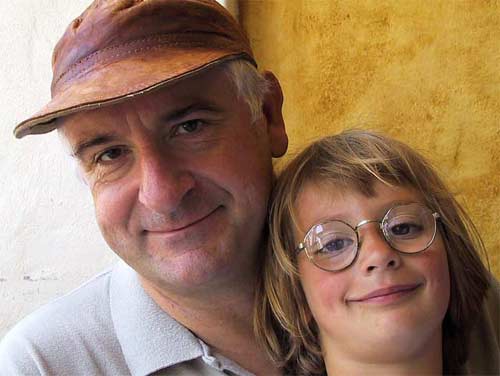
The following is an excerpt from the Douglas Adams video I linked to in this post. Since I can't get a screen capture from the video, I'm including this image of Douglas Adams with his daughter, Polly.


The conclusion of Adams' talk on endangered species:

There is a kind of terrible irony that at the point that we are best able to understand and appreciate and value the richness of life around us, we are destroying it at a higher rate than it's ever been destroyed before. And we are losing species after species after species, day after day, just because we're burning the stuff down for firewood. And this is a kind of terrible indictment of our understanding.

But, you see, we make another mistake, because we think somehow, this is all right in some fundamental kind of way, because we think that this is all sort of "meant to happen".

Now let me explain how we get into that kind of mindset, because it's exactly the kind of mindset that the kakapo gets trapped in. Because, what has been a very successful strategy for the kakapo over generation after generation for thousands and thousands of years, suddenly is the wrong strategy. And he has no means of knowing, because he is just doing what has been successful up till then. And we have always been, because we're toolmakers, because we take from our environment the stuff that we need to do what we want to do and it's always been very successful for us--

I'll tell you what's happened. It's as if we've sort of put the "pause" button on our own process of evolution, because we have put a buffer around us, which consists of medicine and education and buildings, and all these kinds of things that protect us from the normal environmental pressures. And, it's our ability to make tools that enables us to do this.

Now, generally speaking, what drives speciation, is that a small group of animals gets separated out from the main body by population pressure, some geographical upheaval or whatever. So imagine, a small bunch suddenly finds itself stranded ina slightly colder environment. Then you know, over a small number of generations that those genes that favor a thicker coat will come to the fore and you come back a few generations later, and the animal's got a thicker coat.

Man, because we are able to make tools, we arrive in a new environment where it's much colder, and we don't have to wait for that process. Because we see an animal that's already got a thicker coat and we say we'll have it off him. (Laughter.)

And so we've kind of taken control of our environment, and that's all very well, but we need to sort of be able to rise above that process. To rise above that vision and see a higher vision--and understand the effect we're actually having.

Now imagine, if you will, an early man, and let's see how this mindset comes about. He's standing, surveying his world at the end of the day. And he looks at it and things, "This is a very wonderful world that I find myself in. This is pretty good. I mean, look, here I am, behind me is the mountains, and the mountains are great. Because there are caves in the mountains where I can shelter, either from the weather or from bears that occasionally come and try to attack me. And I can shelter there, so that's great. And in front of me is the forest, and the forest is full of nuts and berries and trees, and they feed me, and they're *delicious* and they sort of keep me going. And here's a stream going through which has got fish in it, and the water's delicious, and everything's *fantastic*.

And there's my cousin Ug. And Ug has caught a mammoth! Yay!! (Clapping). Mammoths are terrific! There's nothing greater than a mammoth, because you can wrap yourself in fur from the mammoth, you can eat the meat of the mammoth, and you can use the bones of the mammoth, to catch other mammoths!

Now this world is a fantastically good world for him. And, part of how we come to take command of our world , to take command of our environment, to make these tools that we need, is that we ask ourselves questions all the time. So this man starts to ask himself questions. "This world" he asks himself, "so, who made it?" Now, of course he thinks that, because *he* makes things himself, so he's looking for someone who will have *made* this world. "So, who would have made this world?" he thinks. "Well, it must be something a little bit like me. Obviously *much much* bigger, and (glancing up) necessarily invisible, but he would have made it. Now, *why* did he make it?"

Now, we always ask ourselves "why" because we look for intention around us, because *we* do things with intention. We boil an egg in order to eat it. So, we look at the rocks and we look at the trees, and we wonder what intention is here, even though it doesn't have intention. So we think, what did this person who made this world intend it for. And this is the point where you think, "Well, it fits *me* very well. You know, the caves and the forests, and the stream, and the mammoths. He must have made it *for me*!"

I mean, there's no other conclusion you can come to. And it's rather like a puddle waking up one morning--I know they don't normally do this, but allow me, I'm a science fiction writer (laughter). A puddle wakes up one morning and thinks "Well, this is a very interesting world I find myself in. It fits me very neatly. In fact, it fits me *so* neatly, I mean, *really* precise, isn't it? (Laughter) It *must* have been made to have me in it!" And the sun rises, and he's continuing to narrate the story about this hole being made to have him in it. The sun rises, and gradually the puddle is shrinking and shrinking and shrinking, and by the time the puddle ceases to exist, it's still thinking, it's still trapped in this idea, that the hole was there *for* it. And if we think that the world is here *for us*, we will continue to destroy it in the way in which we have been destroying it, because we think we can do no harm.

There's an awful lot of speculation one way or another at the moment, about whether there's life on other planets or not. Carl Sagan, as you know, was very keen on the idea that there *must* be. The sheer numbers dictate, because there are billions and billions and billions, as he famously did *not* say, in fact, of worlds out there, so the chance must be that there's other intelligent life out there. There are other voices at the moment saying that if you look at the circumstances here on earth, they are *so* extraordinarily specific that the chances of there being something like this out there, are actually pretty remote.

Now, in a way it doesn't matter. Because think of this--Carl Sagan, I think, himself, said this. There are two possibilities: either there is life out there on other planets, or there is no life out there on other planets. They are both *utterly* extraordinary ideas! But, there is a strong possibility that there isn't anything out there remotely like this. And we are behaving as if this planet, this *extraordinary*, utterly, utterly extraordinary little ball of life, is something we can just screw about with any way we like.

And maybe we can't. Maybe we *should* be looking after it just a little bit better. *Not* for the world's sake--we talk rather grandly about "saving the world". We don't have to save the world--the world's fine! The world has been through five mass extinctions. Sixty-five million years ago when, as it seems, a comet hit the earth at the same that there were vast volcanic eruptions in India, which saw off the dinosaurs, and something like 90% of the animals on the planet at the time. And another 150 million years earlier than that, another giant, giant, giant extinction. The world has been through it many times before, and what tends to happen, what happens invariably after each mass extinction, is that there's a huge amount of space available, for new forms of life suddenly to emerge and flourish into. Just as the extinction of the dinosaurs made way for us. Without that extinction, we would not be here.

So, the world is fine. We don't have to save the world--the world is big enough to look after itself! What *we* have to be concerned about, is whether or not the world we live in, will be capable of sustaining *us* in it. *That's* what we need to think about. Thank you very much, ladies and gentlemen. (Applause).

Alternate link for comments

Thursday, January 11, 2007

"America Says No" Rallies

So, whatever happened to the notion that "Elections have consequences"? George W. Bush, after his narrow "victory" over John Kerry in 2004, claimed that he had a mandate to press forward with his agenda, rather than trying to work in a more bipartisan manner. You know, "Reach across the aisle"? Apparently that is only considered an admirable trait when it's Democrats that are in power.

The midterm elections have been described by many as being driven largely by public dissatisfaction with the war in Iraq. From those elections to any public opinion poll I've seen, the message from the American public has been a resounding "No!" to the Bush administration's strategy in Iraq. Bush's response has been the equivalent of sticking his fingers in his ears and yelling "La la la la la!"


For anyone who is not aware of this...

Volunteers will host actions in cities and towns across the country within 24 hours of the president’s speech with a simple message: "America says NO more troops in Iraq!”

I will be the first to admit that I am tired of trying to oppose a president who is so bound and determined to ignore and isolate any voices outside of his small circle of "yes men" (and women). Do I believe that we can change his mind on the escalation of the war in Iraq, announced last night in a special address to the nation? Sadly, no.

But the world is watching us, and I think it would be a sad commentary on American apathy if these rallies were sparsely attended. What does that say to people in other nations (who used to hold our country in such high regard) if our response to Bush acting in direct opposition to our will, is, "Yeah, whatever."

Click here to find a vigil or rally in your area.

Alternate link for comments

Sunday, December 31, 2006

A prayer for the new year


Holy Mother...Loving Father...
Source of All That Is...
Oh--You know who You are!

That daughter You gave me said a funny thing yesterday:
"It seems like God has gotten shy over the years"
(Meaning You don't talk to people like in the "old days")

I said I wasn't sure that was true--
that sometimes it just doesn't get written down
Sometimes people aren't sure it's really You
(Or are afraid to believe that it is)

And I told her of the time I heard from you
(or one of Your "people")
"Help heal the world" were the words I heard
while lying in bed early that morning
And then You held me close

Maybe I imagined that, but it didn't matter
The words felt real enough, and the need for healing was real,
so I promised that I would
Later I learned about tikkun olam,
the Hebrew phase which translates to "repairing the world"

That confirmed the notion that the call to help heal the world was true and real...

It's also impossible

There can never be enough glue, tape, bandages, needles and thread, hammers and nails, hope, patience, and love, to get the job done

I suppose that's why the baptismal vows say, "I will, with God's help"

So as we begin a new year, I ask again for Your help
Help me to find the strength, energy, and love to keep working
to mend that which is broken,
both in myself and in the world You entrusted to our care.

Alternate link for comments

Friday, December 29, 2006

On Poverty

I strongly recommend reading Christy Hardin Smith's post Bringing Poverty to the Table. Yes, as I suspected, the post was prompted by Edwards' announcement yesterday. But even if you support a different candidate, please read. As Christy noted at the end of the piece:

That it has taken a Presidential candidate standing up and talking about this issue to get it back on the front pages of newspapers — at least for the day yesterday — is unconscionable. But at least people are talking about it again, and for that I applaud John Edwards for sticking to a topic that all of us need to be talking about much more frequently.
I don't have a candidate to support yet, as Gore still seems unwilling to run, Feingold has said he won't, and Howard Dean is a man of his word, who promised not to run if elected chair of the DNC. But poverty is one of those uncomfortable, dauntingly big and complex issues that tends to get swept under the rug by the majority. Maybe it's a bit like global warming in that respect. Hurricanes Katrina and Rita were graphic examples of the urgency of both issues--we can't afford to ignore either. So I will join Christy in applauding Edwards getting poverty back into the headlines, even for one day. But I hope it will be for longer than that. Hopefully other candidates and officeholders will join him.

And I don't say this as a supporter of any political candidate. I say it as a human being. I also say it as an Episcopalian who is proud of my new Presiding Bishop who insists on keeping the focus on this issue, in spite of the efforts of others to shift the attention back to issues of human sexuality. From an interview in June of 2006:

Bishop JEFFERTS SCHORI: We need to be examining the poverty that is real around the world. We need to be examining the fact that our brothers and sisters, Anglican and not, in places like Africa and Asia don't have enough to eat. Their children don't have the opportunity to go to school. AIDS and tuberculosis and malaria are rampant in many parts of this world and people with those diseases don't have access to adequate health care. That's where our focus needs to be.

And, from a description of Katharine Jefferts Schori's book, scheduled to be released in January...
Grounding her reflections in a theology of the reign of God—‘God’s dream for creation’—she dares to ‘dream big’ herself, casting a vision of a world without poverty and hunger, where we all recognize our interdependence with every other child of God.
Jefferts Schori's book can be preordered here.

And I have heard those words echoed by Bishop Gene Robinson, and by Archbishop Desmond Tutu, and by many other people I respect and admire. I hope that more and more people will talk about it--especially people who have an audience. And when people try to distract us with something shiny, I hope that we will redirect, and bring the discussion back to issues of vital importance for our human family.

(Also posted at Daily Kos, My Left Wing and Street Prophets)

Update: I just discovered that Part II of Christy's discussion of poverty is now posted at FDL.

Alternate link for comments

Tuesday, December 26, 2006

Oplatki

Here's a required part of Christmas when celebrated with my Mom's family:


One of the most beautiful and most revered Polish customs is the breaking of the oplatek. The use of the Christmas wafer (oplatek) is not only by native Poles in Poland but also by people of Polish ancestry all over the world.

The oplatek is a thin wafer made of flour and water. For table use, it is white. In Poland, colored wafers are used to make Christmas tree decorations. In the past, the wafers were baked by organists or by religious and were distributed from house to house in the parish during Advent. Today, they are produced commercially and are sold in religious stores and houses. Sometimes an oplatek is sent in a greeting card to loved ones away from home.

Family members extend oplatki (plural--oplatek is the singular) to one another, and break pieces off, offering good wishes and blessings for the coming year.

Every year we know that Oplatki Time is coming. It's awkward--like knowing you will be required to give a mini-speech to people you haven't seen since last year. Every year someone jokes about not doing it, or tries to barter it down to just holding up the wafers and making one big communal Christmas wish/blessing. But we always do the thing. It's tradition, dang it.

Thank you to everyone who contributed to Heifer in my Mom's honor. She was really surprised, and quite touched. Will share more later, but now it's family time.

Friday, December 22, 2006

Countering Anti-Muslim bigotry

Note: I started this post at the beginning of the month and then got very busy with Christmas preparations and various events for the kids. But today, after more recent developments, such as Virginia Represenative Virgil Goode's letter about the importance of tightening immigration restrictions to avoid an "influx of Muslims", I decided I'd better post it.

What I wrote earlier this month...

From Yahoo News: In U.S., fear and distrust of Muslims runs deep


When radio host Jerry Klein suggested that all Muslims in the United States should be identified with a crescent-shape tattoo or a distinctive arm band, the phone lines jammed instantly.

Another said that tattoos, armbands and other identifying markers such as crescent marks on driver's licenses, passports and birth certificates did not go far enough. "What good is identifying them?" he asked. "You have to set up encampments like during World War Two with the Japanese and Germans."

At the end of the one-hour show, rich with arguments on why visual identification of "the threat in our midst" would alleviate the public's fears, Klein revealed that he had staged a hoax. It drew out reactions that are not uncommon in post-9/11 America.
A video of news segment about this story can be seen at Crooks and Liars.

Here is a link to some columns by Dr. Asma Mobin Uddin, a Columbus area pediatrician and member of the Muslim faith. She makes public appearances (one at my church a couple years ago) to help people learn more about the misunderstood and sometimes mistrusted faith to which she belongs, has written columns for the Faith and Values section of the Columbus Dispatch, and has written a children's book, My Name is Bilal...
Synopsis:
Bilal worries about being teased by his classmates for being Muslim. He thinks maybe it would be better if people don't know he is Muslim. Maybe it would be best if he tells kids his name is Bill rather than Bilal. Then maybe they would leave him alone. Mr. Ali, one of Bilal's teachers and also Muslim, sees how the boy is struggling. He gives Bilal a book about the first person to give the call to prayer during the time of the Prophet Muhammad. That person was another Bilal: Bilal Ibn Rabah. What Bilal learns from the book forms the compelling story of a young boy wrestling with his identity.
Alternate link for comments

Thursday, December 21, 2006

What part of "all" don't these people understand?

Some disheartening stories I've seen recently...

Congressman Fears Influx of Muslims
Right Wing Questions Obama's Loyalty

I know I've posted these words from Bishop Desmond Tutu before, but apparently it's a lesson that needs repeating before it really sinks in.

And, God says, God says, "Yes, I do have a dream. Like, Martin Luther King, Jr." God says, "I, too, have a dream. I dream that my children one day will discover that they are family."

Now, that, actually, is not sentimental. It's one of the most radical things that Jesus ever uttered: "They are family." Family, you don't choose your relatives. Sometimes you wish you could. Family: a gift from God to you. And you: a gift to them from God.

And, in this family, there are no outsiders. Just all, all… all belong. It's an incredibly radical thing. All, all, all. You see, when Jesus spoke about… "If I be lifted up, I will draw…" he didn't say I will draw some. He didn't say I will draw some. He said, "I will draw all, all into this incredible divine embrace of love." All. Beautiful, not so beautiful. Tall; stumpy, like me. … Rich, poor, white, black, red. All, all, all, all. All belong. All. All. Gay, lesbian, so-called straight, all. [Laughter and applause.] All, all. All. All. [Applause.] All. All. All. All. All. Sharon, Arafat, all. Roman Catholic, Protestant in Northern Ireland. All. All. All. Bush, bin Laden. All. It's quite serious because, you see, God has no enemies.
By the way, one way to help those family members who are living in hunger and poverty, is through a donation to Heifer International. I've set up a page, with a modest goal of $250, here.

Alternate link for comments