

 Way back in another lifetime, when my son was 2 1/2 and my daughter was around six months old, I took a job teaching part time. This was not my first time teaching--I had taught several sections of introductory paychology as a teaching associate while I was in grad school. This time around, I was teaching a section of Development Across the Lifespan. One of the first things I noticed when I cracked open that textbook was the way life was divided into stages. I was pleased to see that, being in my early 30s, I was still officially a "young adult", and that I would not cross the threshold into midlife until I turned 40. So as I read in more detail about that stage, it was a bit like reading about a distant land that I would likely visit one day, but that was a long way off and it was way to early to start making plans. One of the things I remember from that text is the discussion of the "midlife crisis"? What was it--and was there even necessarily a crisis at midlife? One view was that it was really a "midlife transition" which, to be sure, was full of changes. But they were changes you could see coming, and could prepare for. That made a certain amount of sense when I first read it. Now, I think it's a crock. I mean, sure, you can (and should) plan for the future as you make life decisions. You know that you're supposed to save up for tuition and retirement--even if you don't always manage to sock away as much as you should. And if you're considering a new home or a new job, you will ask yourself not just "what is the best choice for right now?", but also "how will this decision affect my life down the road?" So, there are some concrete things you can plan for. But can you really anticipate what it's like to be in a different life stage? In my mind, there is a big difference between knowing something is coming and actually being "ready" for it. Ayway, within the past several months, some of what I read in that textbook has started to come back to me. One thing in particular stands out…a finding that, in long term marriages, marital satisfaction hits a low point in midlife. There was speculation about possible reasons for this, but I got the impression it was no coincidence that marital bliss hit rock bottom right around the time the couple was likely to be raising teenagers. You don’t say... So what I was experiencing was...normal? I find that vaguely reassuring. The unhappiness I was feeling DID seem to center around the challenges of raising teens, particularly the way my husband just didn’t seem to “get” what our daughter was doing to me. Seriously, how could he not see that? It was happening right in front of him. Our daughter would rip my heart right out of my chest, show it to me, and then step on it. You think I’m being melodramatic, don’t you? I'm not saying she took sadistic pleasure in it, or did it maliciously, but she was definitely doing it. I'll even grant you that she wasn’t throwing it down and stepping on it intentionally. Let's say she dropped it because she wasn’t really paying attention. No doubt she found it "boring", so it would slip out of her hand while she was absorbed in something else. By the time she accidentally stepped on it, she'd most likely forgetten that she was ever holding it. Early in 2009 I received a call asking if I would be interested in working on a test scoring project out of state. I was told that the project would start in late April and would last a little more than a month. I can't remember anything specific about the morning I got that call, but I am certain that, for one reason or another, my heart had a fresh set of scuff marks on it. The practical, okay-to-say-out-loud facts were as follows: it would be good money, and there would be an extended period of time that we didn't have to worry about needing to press the crappier of our two cars into service. But there was another thought. I had just been offered a socially sanctioned way of running away from home. And just moments earlier, whether I knew it or not, that's exactly what I had been wishing for. Well, as it turns out, a lot went wrong for me on that trip. I didn't get the down time I'd hoped for. All in all, it was pretty disappointing--but maybe that’s for the best. Had things gone well, I might have enjoyed the experience a little too much. So, to paraphrase a song, you can't always get what you want, but sometimes you get what you really need. Maybe Someone was looking out for me on that count. All I know is that one day I texted Demetrius that I had learned two important lessons during my time away. The first was that I missed him more than I thought I would. It's not that I didn't think I would miss my husband. It's just that I already missed my sweetie when we were coexisting in the same house. I thought maybe missing him when we were actually separated by hundreds of miles might suck slightly less. (It didn’t.) The second realization, I texted, was that “working for other people sucks”. I was very much looking forward to coming home, living together under the same roof again, and working together on our online stores. So it's good to be home, and I know that this is where I belong. This is a rough stage we're in right now, and we're going to have to try extra hard to find the beauty and laughter wherever we can. I hear it gets better--in these long term marriages--after the kids are out of their teens. I know that we will be okay as a couple. I don't have the same level of confidence about my relationship with my daughter. I can hope, of course. And watch for opportunities to make connections--without "trying too hard", of course. Ugh. We're talking about the only person I can say I genuinely fell in love with at first sight--the very moment when, after difficult and exhausting hours of labor, my baby daughter was placed in my arms. There was a time when I could count on her being up for a spontaneous fun outing when I needed a pick-me-up. Just little things like petting the kittens at the shelter, or going to the park, or stopping at the bread store that gives free slices of fresh-from-the-oven baked goods. But it's even more the loss of companionship and diversion. Our times together and the conversations we would have often gave me insights. They inspired me to think about some aspect of life in a new way, and this in turn would inspire me to write something. I've had a hard time writing much of anything for a long time now. I haven't delved too deeply into why that might be, but if pressed I would probably have said that I was just too busy to get in the right frame of mind and really devote time to writing something. Or maybe I would say that things were going kind of crappy, and writing about that was not exactly a good "pick-me-up". But this week, a new answer came to me. There's this young lady living in my home. Her name and face are familiar, but I don't really know her. I want to get to know her, but my efforts have been rebuffed time and again. I don't want to give up, but being rejected again and again takes its toll. So I've had a new insight into why I've been experiencing this killer writer's block. My daughter used to be a big part of my inspiration for writing. In recent years, she didn't just stop being an inspiration in terms of my writing. I think she's actually become my "Kryptonite". That really was an "aha" moment for me. I've definitely figured something out. But what to do with this insight? Don't know yet. One thing at a time... |
Saturday, July 11, 2009
Living with Kryptonite

Sunday, June 08, 2008
On sinners and tax collectors
|

Friday, February 08, 2008
Overheard at the gym
First, a disclaimer...I would very much prefer not to overhear other people's conversations at the gym. I try to go at least twice a week, three times if I'm lucky, and what I want to do is get in the pool and move. I'm not much of a swimmer, but I used to take water aerobics classes, and now I just go to the pool when I have the opportunity and do "freestyle water aerobics for one". I don't ask for much--I just want my own little spot near a wall where I can just do my thing and tune everybody else out. If conditions are right, that's where I can do some of my best creative thinking. But if people within earshot are having a conversation, then conditions are most definitely not right, and I can't seem tune them out no matter how hard I try. "I stayed up way too late last night watching the returns."At this point, I *really* wanted to be able to tune out, because I was afraid I might hear something that would annoy me enough that I'd feel compelled to butt into their discussion. But the water wasn't loud enough to drown them out, so as I finished up my shower, I heard the conversation turn to the subject of women priests, and how one of the women had a friend who is one, but, "something about that is just not right." Also, apparently the women's movement is to blame for "the mess we're in today". Whatever that is. But I wouldn't be sharing this story with you now, if it didn't have a positive twist. Here it comes. One of the women said (paraphrased) I didn't hear what the other women said in response, but inside I was saying "Right on, sister!" Because every day, in small ways we have opportunities to speak up and give the other side of the story. And an alternative perspective, when shared by "someone like you" has a better chance of taking root and possibly, as time goes on, softening (or even changing) some of the judgments people make. |
Sunday, January 13, 2008
In which I owe my dog an apology
Originally posted at Street Prophets 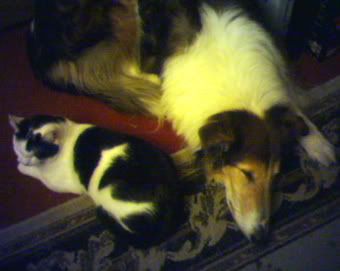 I wrote about Brady and our trips to the dog park a little over a month ago. I haven't been able to take him there as often as I'd like, but when we do go, he always enjoys himself. Today was the first day in a while that I've thought the weather was nice enough to head out with him, and he was *more* than ready. And, of course seeing him that happy and excited is very satisfying for me. He's such a sweet boy, albeit a bit clueless. At least, that's how he seemed to me when he was running with the other dogs. I remarked once that Brady is "not the sharpest knife in the drawer", to which my husband responded, "I think he might be a spoon!" Today at the dog park, I realized that maybe *I* had been the clueless one. As we pulled into the parking lot near our local "Bark Park", I could tell that Brady was overjoyed to be there. He trotted energetically at my side as we walked up the pathway leading to the park. Once we were inside and he was off leash, he got down to business--leaning on all the receptive humans and greeting all the dogs. And then, invariably, one of the humans throws a ball, other dogs chase the ball, and Brady happily runs alongside them. That's the part that always seemed clueless to me. Like Brady was saying, "I don't know what were doing, but we're having fun!" This time, while Brady was doing his running adjacent to the action routine, |
Saturday, December 01, 2007
What my dog taught me
This started as a comment in response to Dogs, Doorwalls and Dianisms at My Left Wing. Somewhere along the way, the comment got long enough to actually be a post. That doesn't seem to happen to often lately, so I decided to go with it... |
Monday, November 12, 2007
Zimbardo on "nurturing the heroic imagination"
"The line between good and evil cuts through the heart of every human being", says Aleksander Solzhenitsyn. ... "It's a decision that you have to make every day in various ways." |

Sunday, October 07, 2007
Bless all creatures here below
Daughter sang with the children's choir today, and, since this is the Sunday closest to the Feast of St. Francis, the hymns centered around that. The opening hymn was one I'd never heard before, and it was *adorable*. There were three more verses. The last line, though, is what made me well up: When at last we come to you, let our creatures be there too Our creatures have just got to be there. If they're not, how could it be heaven?  |
Subscribe to:
Comment Feed (RSS)