

I just don't seem to have the attention span or focus needed to keep up with multiple complex issues--especially at those times that I am working during the day. So while I've been focussed on how those with smaller blogs can find some way to cooperate in a way that is mutually beneficial, while still retaining their independence, I've completely lost track of some other things. For example, I had totally blanked on the fact that the bishops in the Anglican Communion were having a major meeting this week. Seven "Global South" archbishops refused to receive Holy Communion with their fellow Primates February 16, alleging that they were "unable to come to the Holy Table with the Presiding Bishop of The Episcopal Church because to do so would be a violation of Scriptural teaching and the traditional Anglican understanding."Now, I have tremendous admiration for Bishop Katharine. Archbishop Akinola, not so much. But while my first thought was just about the "snub" aspect of the action. It was only a little later that it occurred to me the extent to which this action goes against something that was really central for Jesus. From the web site of The Center for Progressive Christianity: It is probably no coincidence that many scholars today believe the stories about Jesus’s open table are considered some of the most authentic historical passages in the gospels, in part because they are so unique for the times. Marcus J. Borg wrote in Meeting Jesus Again for the First Time, “one of his (Jesus’s) most characteristic activities was an open and inclusive table.” (p.55) Later he notes that, “The inclusive vision incarnated in Jesus’s table fellowship is reflected in the shape of the Jesus movement itself.” (p. 56)And on the subject of food, I found something interesting at a new blog called epiScope. The post is entitled "Virginia Ham", and it discusses the "unreasonable rift" in the Episcopal Church... But in the present rift among our Episcopalian neighbors, one feels it is not so much deviant ideas, but how deviant behavior is defined. As we have recently seen, Virginians regard homosexuality as deviant and, I continue to insist, abhorrent. As we have also seen, they are loath to acknowledge this abhorrence, claiming, for the most part, they are constrained to obey the edicts inscribed in the book of Leviticus. Well, Leviticus prescribes dire consequences for any of us who fancy Virginia ham as well.Good one--wish I'd thought of it. (Given that the most publicized recent rift in the Episcopal Church in the United States has been in the Diocese of Virginia.) More here. Alternate link for comments |
Sunday, February 18, 2007
Table fellowship and Virginia ham

Friday, February 16, 2007
Just doing what the voices tell me...
I used that line the other night in response to someone who has tried to "reason" with me about the futility of my latest internet project. I was being tongue in cheek, but I was also referring to something I've addressed before, in my story God, the Blue Puppy. As the mother of young children who watched Blue's Clues, I enjoyed the idea that God left little "clues" to let me know when I was on the right track toward fulfilling the purpose She has in mind for me. Of course, now that my kids are 11 and 13, that show is a distant (sometimes pleasantly nostalgic) memory, so I don't talk about "God's Clues" any more. But from time to time I do feel "called", for lack of a better word, to take action. How do I know it's something I'm meant to do? 1. It feels out of character and scary. 2. The damn thing just won't go away. So, while I don't have a name for that insistent feeling that there is something I must do, there is an image/metaphor that seems to pop into my mind: Joan of Arc. Of course, the big problem with that...
But the blogroll purge which, as I have already stated, does not affect me personally, has been the catalyst that prompted me to revisit some of these issues. Also an overarching issue that I have noticed over time: the man really tries to have it both ways. On the one hand, he's been quoted as saying that he is "not a leader" or that he's "just a guy with a blog". But on the other hand, he has often behaved like a very autocratic guy who just "happens" to have one of the most widely read blogs on the Democratic side of the aisle. And he has a great degree of power over what issues can see the light of day in front page posts. Anyway, in addition to work, digging out from the snow, and just generally the day to day responsibilities of an ordinary American who does *not* have ad space worth $9000 a week needs to keep up with, this is what I've been working on lately...  |

Saturday, February 03, 2007
Puppy Bowl!
I can't help myself--everywhere I look on the internets (well, the bloggy part of the internets, at least) I'm seeing posts about the Super Bowl. And I. just. don't. care. Animal Planet has reinvented the Big Game with the cutest, fuzziest and - at times- fiercest players on the field. When we say "rookie" we aren't kidding - some of these athletes are just nine weeks old. From bulldogs to boxers and everything in between, it's a fantastic team playing in a spectacular brand-new stadium. Join us for tackles, fumbles and fouls on the third annual Animal Planet Puppy Bowl premiering Sunday, February 4, 3-6 p.m. ET with encore presentations at 6 p.m. and 9 p.m. ET only on Animal Planet. Click here for more. Alternate link for comments |

Saturday, January 27, 2007
Douglas Adams speech excerpt
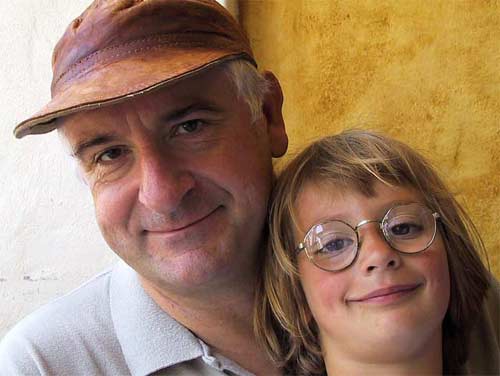
The following is an excerpt from the Douglas Adams video I linked to in this post. Since I can't get a screen capture from the video, I'm including this image of Douglas Adams with his daughter, Polly. |
Thursday, January 11, 2007
"America Says No" Rallies
So, whatever happened to the notion that "Elections have consequences"? George W. Bush, after his narrow "victory" over John Kerry in 2004, claimed that he had a mandate to press forward with his agenda, rather than trying to work in a more bipartisan manner. You know, "Reach across the aisle"? Apparently that is only considered an admirable trait when it's Democrats that are in power. Volunteers will host actions in cities and towns across the country within 24 hours of the president’s speech with a simple message: "America says NO more troops in Iraq!” I will be the first to admit that I am tired of trying to oppose a president who is so bound and determined to ignore and isolate any voices outside of his small circle of "yes men" (and women). Do I believe that we can change his mind on the escalation of the war in Iraq, announced last night in a special address to the nation? Sadly, no. But the world is watching us, and I think it would be a sad commentary on American apathy if these rallies were sparsely attended. What does that say to people in other nations (who used to hold our country in such high regard) if our response to Bush acting in direct opposition to our will, is, "Yeah, whatever." Click here to find a vigil or rally in your area. Alternate link for comments |

Sunday, December 31, 2006
A prayer for the new year
 Holy Mother...Loving Father... Source of All That Is... Oh--You know who You are! That daughter You gave me said a funny thing yesterday: "It seems like God has gotten shy over the years" (Meaning You don't talk to people like in the "old days") I said I wasn't sure that was true-- that sometimes it just doesn't get written down Sometimes people aren't sure it's really You (Or are afraid to believe that it is) And I told her of the time I heard from you (or one of Your "people") "Help heal the world" were the words I heard while lying in bed early that morning And then You held me close Maybe I imagined that, but it didn't matter The words felt real enough, and the need for healing was real, so I promised that I would Later I learned about tikkun olam, the Hebrew phase which translates to "repairing the world" That confirmed the notion that the call to help heal the world was true and real... It's also impossible There can never be enough glue, tape, bandages, needles and thread, hammers and nails, hope, patience, and love, to get the job done I suppose that's why the baptismal vows say, "I will, with God's help" So as we begin a new year, I ask again for Your help Help me to find the strength, energy, and love to keep working to mend that which is broken, both in myself and in the world You entrusted to our care. Alternate link for comments |
Friday, December 29, 2006
On Poverty
I strongly recommend reading Christy Hardin Smith's post Bringing Poverty to the Table. Yes, as I suspected, the post was prompted by Edwards' announcement yesterday. But even if you support a different candidate, please read. As Christy noted at the end of the piece: That it has taken a Presidential candidate standing up and talking about this issue to get it back on the front pages of newspapers — at least for the day yesterday — is unconscionable. But at least people are talking about it again, and for that I applaud John Edwards for sticking to a topic that all of us need to be talking about much more frequently.I don't have a candidate to support yet, as Gore still seems unwilling to run, Feingold has said he won't, and Howard Dean is a man of his word, who promised not to run if elected chair of the DNC. But poverty is one of those uncomfortable, dauntingly big and complex issues that tends to get swept under the rug by the majority. Maybe it's a bit like global warming in that respect. Hurricanes Katrina and Rita were graphic examples of the urgency of both issues--we can't afford to ignore either. So I will join Christy in applauding Edwards getting poverty back into the headlines, even for one day. But I hope it will be for longer than that. Hopefully other candidates and officeholders will join him. And I don't say this as a supporter of any political candidate. I say it as a human being. I also say it as an Episcopalian who is proud of my new Presiding Bishop who insists on keeping the focus on this issue, in spite of the efforts of others to shift the attention back to issues of human sexuality. From an interview in June of 2006: Bishop JEFFERTS SCHORI: We need to be examining the poverty that is real around the world. We need to be examining the fact that our brothers and sisters, Anglican and not, in places like Africa and Asia don't have enough to eat. Their children don't have the opportunity to go to school. AIDS and tuberculosis and malaria are rampant in many parts of this world and people with those diseases don't have access to adequate health care. That's where our focus needs to be. And, from a description of Katharine Jefferts Schori's book, scheduled to be released in January... Grounding her reflections in a theology of the reign of God—‘God’s dream for creation’—she dares to ‘dream big’ herself, casting a vision of a world without poverty and hunger, where we all recognize our interdependence with every other child of God.Jefferts Schori's book can be preordered here. And I have heard those words echoed by Bishop Gene Robinson, and by Archbishop Desmond Tutu, and by many other people I respect and admire. I hope that more and more people will talk about it--especially people who have an audience. And when people try to distract us with something shiny, I hope that we will redirect, and bring the discussion back to issues of vital importance for our human family. (Also posted at Daily Kos, My Left Wing and Street Prophets) Update: I just discovered that Part II of Christy's discussion of poverty is now posted at FDL. Alternate link for comments |
Subscribe to:
Comment Feed (RSS)
